


Solar wind
speed: 412.0 km/secdensity: 6.8 protons/cm3 more data: Met Office, DSCOVR Updated: Today at 0912 UT 
X-ray Solar Flares
6-hr max: C3 0441 UT [[monthName]] [[day]]24-hr: M1 2118 UT explanation | more data Updated: Today at 0930 UT
Daily Sun: [[day]] [[monthName]] [[year]]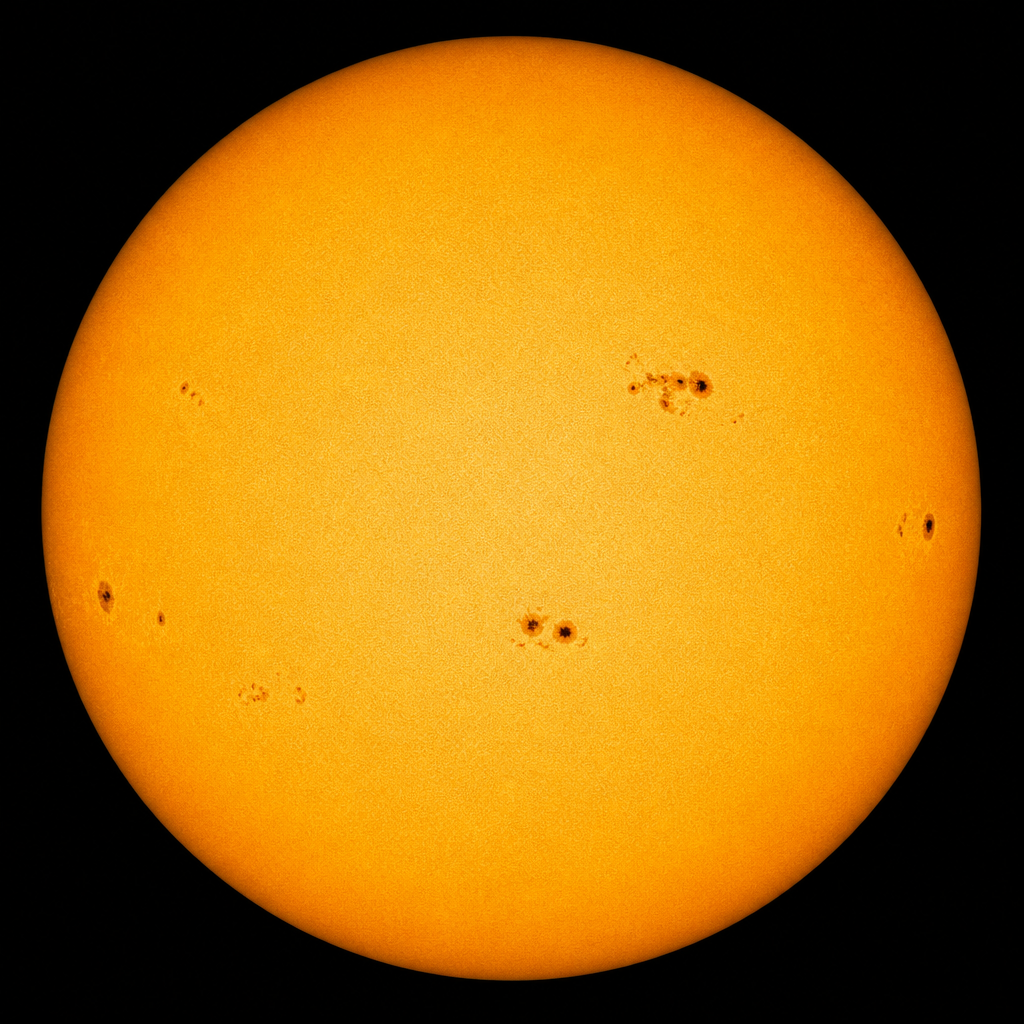 Sunspot groups on the Earth-facing disk carry mixed polarity capable of M-class flares. Credit: illustration for Scienception based on typical SDO/HMI appearance.
Sunspot number: 91 What is the sunspot number? Updated [[day]] [[monthName]] [[year]]  Current Auroral Oval:
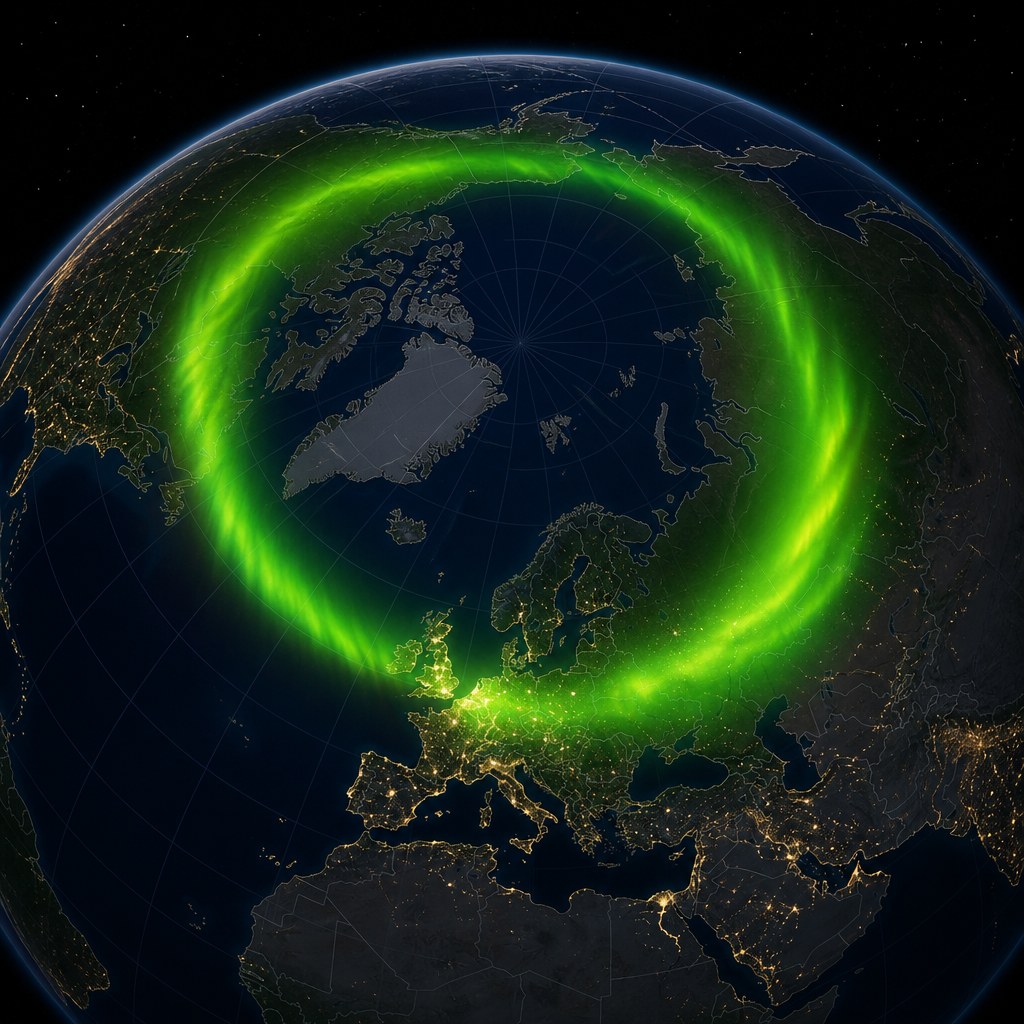 Credit: oval visualisation for Scienception. See also AuroraWatch UK
Planetary K-index
Now: Kp= 2.00 quiet24-hr max: Kp= 3.33 unsettled explanation | BGS data
Interplanetary Mag. Field
Btotal: 6.1 nTBz: -2.4 nT south more data: MOSWOC Updated: Today at 0928 UT
Coronal Holes: [[day]] [[monthName]] [[year]]
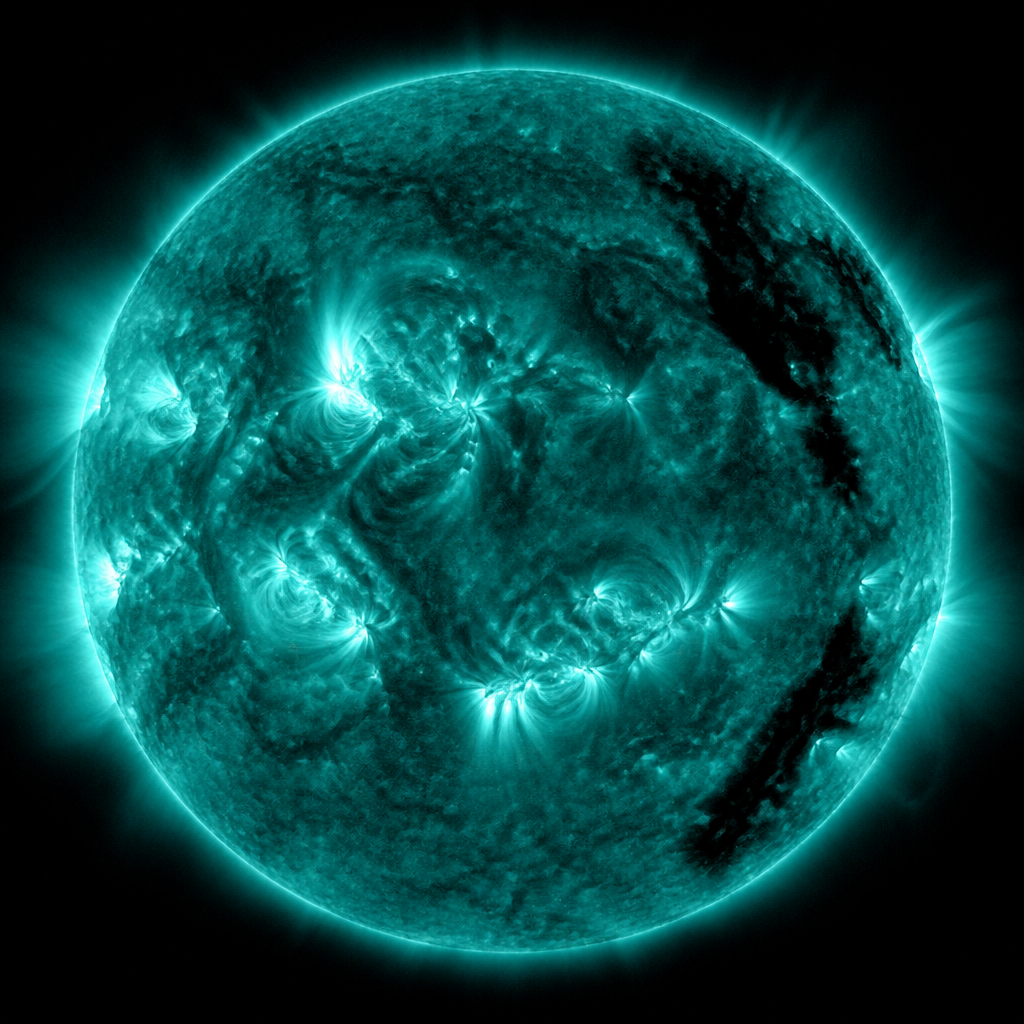 Solar wind from the marked coronal hole is expected to reach Earth in 2–3 days. Credit: illustration for Scienception.
SIDC | more
Spotless Days
Current stretch: 0 days[[year]] total: 2 days (<1%) 2025 total: 0 days (0%) 2024 total: 0 days (0%) Updated [[day]] [[monthName]] [[year]]
The Radio Sun
10.7 cm flux: 132 sfuexplanation | more data Updated [[day]] [[monthName]] [[year]]

SPACE WEATHER
Guidance styled after Met Office MOSWOC products. Updated [[day]] [[monthName]] [[year]] 0000 UTC
UK Forecasts
Mid-latitudes (England, Wales)
|
Monday, [[monthName]]. [[day]], [[year]]
GlossaryScienception uses operational language. These are the short versions. Planetary K-index (Kp)A 0–9 scale of geomagnetic activity over three-hour windows. Quiet is low single digits. Storms live at the top. BGS observatories are how the UK actually measures the field. See BGS geomagnetism. X-ray flare classesA, B, C, M and X, each ten times the last. C is common at solar maximum. M can disturb HF radio. X is major. A letter plus a number (C3, M1) is the size within the class. G-scale stormsG1 minor through G5 extreme describes geomagnetic storm intensity. A G1 watch for the UK is mainly a high-latitude aurora and radio story. Severe grid impacts live at the rare end of the scale. Sunspot numberA weighted count of spots and groups. It is famous, observer-dependent, and a cousin of the 10.7 cm radio flux rather than a substitute for solar-wind data. Coronal holesOpen magnetic regions. Fast solar wind streams from them and can rattle Earth's field a few days after the hole faces us. 10.7 cm flux (F10.7)Daily radio brightness of the Sun at 10.7 cm, in solar flux units. Ionospheric models consume it. See the left-hand rail on the homepage. Coronal mass ejection (CME)A magnetic cloud thrown off the Sun. It may glance Earth, miss, or drape. Geometry, not the size of the flare, decides whether Britain gets an oval, a Forbush decrease, both, or neither. Forbush decreaseA drop in galactic cosmic-ray intensity at the ground when a CME's magnetic field sweeps particles aside. Neutron monitors see it. Aurora cameras may not. Longer explainer. IonosondeA radar that looks up and times echoes from the E and F layers. Critical frequency is the operational number. The UK series around Chilton is how Britain remembers the ionosphere. Chilton and UKSSDC. MagnetopauseThe moving wall where the solar wind meets Earth's magnetic field. In-situ craft pierce it. SMILE is designed to image it. SMILE at MSSL. Noctilucent cloudsIce at about 80 km, lit after the ground is dark in high-latitude summer. Not aurora. Not tropospheric cirrus. Scotland still has the best UK seats. F10.7 explainer · G1 watch explained in place · JUICE as planetary space weather |

Satellite notes
Tracked objects in orbit: 10,000+ Re-entries of interest this month: 4 visible from the UK Updated [[day]] [[monthName]] [[year]] Sources: Aerospace Corp, ESA debris
Met Office Space Weather
Official UK space-weather forecasts from MOSWOC
British Geological Survey geomagnetism
UK magnetometer network and GIC research
UK Space Agency
Civil space policy and SWIMMR programme context
RAL Space
STFC solar and heliospheric instruments
ESA Solar Orbiter
Close-up science of the Sun
Solar Dynamics Observatory
Full-disk EUV and magnetograms
UK Solar System Data Centre
Ionospheric and solar-terrestrial archives
Jodrell Bank
Radio astronomy and public outreach
|

© [[year]] Scienception LTD. All rights reserved. Scienception is a United Kingdom science publication operated by Scienception LTD, .